Showing posts with label oystercatcher. Show all posts

Saturday, April 07, 2007

Beds birding

Started in Cambridgeshire, at Croydon. It's the highest point in the county and you can walk along the ridge, with nice views across the border into Bedfordshire.

Skylark

The abandoned medieval village of Clopton

A fox was hunting rabbits among the earthworks

Next stop, Broom gravel pits. Move along now, there's nothing for you here...

Yellowhammer

A pair of Oystercatchers fed along one of the pits. The bird not in this photo was ringed

Next, Pegsdon Hills, a Wildlife Trust reserve.

Peacocks were quite plentiful on the blossom

Meadow Pipits were in song all over the hill

Ring Ouzel record shot for Darren...

They have some nice sheep grazing the slopes

Triangulation point

Unusual subject matter for a pub sign nearby


Dog-violet

Sand Martins back at their colony along Meadow Lane

Ringed Plover at Willington

bird/insect photos taken with Canon EOS 30D, EF 300mm f/4L IS USM

macro/landscape photos taken with Nikon Coolpix 995 + Leica Apo Televid 77 with 20x eyepiece

Friday, January 06, 2006

Norfolk

Extract from my 'other' blog, The Not Very Big Year...


Hunstanton Cliffs - home to Fulmars and Feral Pigeons

Sometimes, when it's cold, grey and miserable, I wonder why it is I bother to go birdwatching. Wednesday was a good [bad] example. Crap weather and no birds.

I think the setting must make all the difference, because today Norfolk was cold, grey and miserable - the sun never came out - but there were some great birds to be seen and I wasn't quite as grumpy as normal.

We hadn't even reached our first planned stop when long skeins of Pink-footed Geese began crossing the skies above us. Birds going from their night-time roost sites to their daytime beet-field feeding hang-outs. It's a Norfolk birding cliche, but always an awesome sight, not to be sniffed at.

On a cold January Friday morning, it was quiet on Hunstanton seafront and Turnstones scuttled around in the gutter, in the manner of Starlings, while Herring Gulls lurked in gardens and car-parks.


Herring Gull - king of the British seaside resort

But they weren't our 'sunny-Hunny' target birds. No, we wanted Fulmars, and we got them, as they glided stiffly around the cliffs on their mini-albatross wings.

Below, family parties of Brent Geese indulged in a little breakfast-time surfing and pecked at the seaweed which encrusted the boulders below the cliffs. More Turnstones, Oystercatchers and Redshanks there, but sadly no Purple Sandpipers.


Oystercatcher hammers mussel while Redshank can only watch

Time to look out to sea. Well, into The Wash, anyway. With no wind, seawatching conditions weren't exactly ideal, but it made it a lot more comfortable.

It wasn't too long before one Red-throated and one Great Northern Diver came into view. Not close by normal birding standards, but good for seawatching. Much closer was a Guillemot, to Darren's great delight. They don't get many in Bedfordshire so he hadn't seen one before.


Darren's first Guillemot

I think that means he owes me a pint.


RSPB Titchwell meeter-and-greeter

Darren is quite derogatory about 'Titchwell Zoo', as he calls it, but I reckon you can't knock it too much. Wander down the track to the beach and there are Spotted Redshanks feeding, unperturbed, virtually within spitting distance.


Spotted Redshank

On the sea, a slick of Common Scoters was forming. Trails of birds from further offshore made up a flock of around 3,000 birds - another impressive sight which included about eight Velvet Scoters. Slightly closer, a couple of smart, piebald Slavonian Grebes (another lifer for DO-M, and it wasn't even lunchtime) pootled about, and a small group of Red-breasted Mergansers bobbed around on the waves.


The scoter flock off Titchwell beach

A drive up to Choseley found a flock of around 400 Corn Buntings and some very pleasant, canary-yellow Yellowhammers. Titchwell drew us back again, with news of a Bean Goose with a flock of Pinkfeet on fields by the entrance. More than an hour's scrutiny of the flock, in terrible light, failed to nail the bird conclusively... Still, it's not a British breeding species so we don't need it for our list anyway.

Species added today:
Pink-footed Goose
79. Herring Gull
Turnstone
80. Oystercatcher
Brent Goose
81. Fulmar
Bar-tailed Godwit
82. Guillemot
83. Red-throated Diver
Great Northern Diver
Sanderling
84. Shelduck
85. Curlew
86. Little Egret
87. Cetti's Warbler
88. Egyptian Goose
Spotted Redshank
89. Black-tailed Godwit
90. Ringed Plover
91. Dunlin
Knot
Grey Plover
92. Common Scoter
Velvet Scoter
93. Slavonian Grebe
94. Red-breasted Merganser
95. Avocet
96. Corn Bunting
97. Grey Partridge
98. Merlin
99. Barn Owl


photos taken with Nikon Coolpix 995 + Leica Apo Televid 62 with 16x eyepiece

Saturday, November 05, 2005

Snettisham wader roost


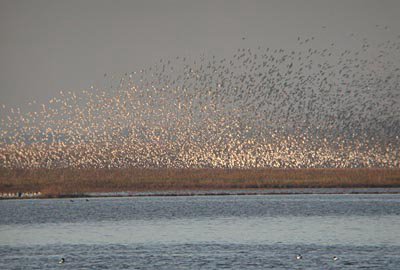
The high-tide wader roost at Snettisham is famous, and rightly so. Time your visit right and you can enjoy the spectacle of thousands of waders flying closer and closer to you, chased by the waters of the Wash.


The weather conditions this morning were good... sunny and not too windy, although it was plenty cold enough for me. So when the flocks of Knot and Bar-tailed Godwit turned in the air, they positively shimmered, looking grey-brown one second and sparkling white the next.


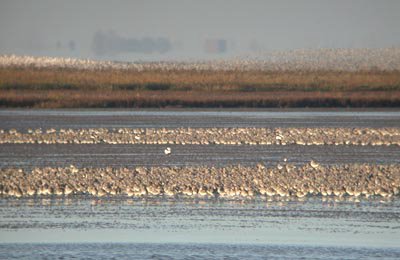
Eventually, the flocks gathered close to the shore (and the hide) to rest, forming tightly-packed groups - Knot in the middle, Bar-tailed Godwits around the edge, Oystercatchers quite separate.

The noise made by the birds was just as amazing as the sight they made. I thought I could hear a distant train rushing by, at one point, but realised it was the cries of the waders and their wings beating through the air.


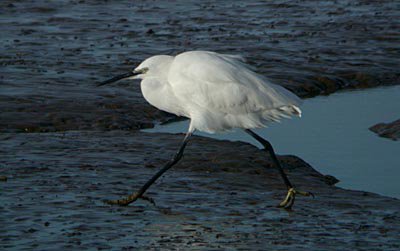
A close-up Little Egret also provided some entertainment on the walk back.

photos taken with Nikon Coolpix 995 + Leica Apo Televid 62 with 16x eyepiece

Tuesday, June 22, 2004

RSPB Titchwell Marsh, Norfolk

With some time off work I decided it would be nice to go to RSPB Titchwell for some digiscoping. Everything's close there, isn't it? All the birds seem tame.


Highlight was this male Ruff which showed well close to the main path. That's a real ruffy Ruff. And if that's not a mullet, I don't know what is...


I made numerous attempts at photographing Avocets (which were plentiful), but in 90% of my shots, the birds had their heads underwater. Never mind.


A very showy Sedge Warbler perched by the entrance to one of the hides and sang right out in the open, until it was flushed. That's the only problem with Titchwell - it's very busy.


There wasn't a lot on the beach, except for a few Oystercatchers.


A couple of summer-plumaged Spotted Redshanks looked smart but were a little distant for me.

What's in my CD player: Being There - Wilco