We also caught a few Long-tailed Tits, including a bird first ringed in autumn 2009, so it's now in at least its sixth calendar year (as a minimum). Not bad for a little bird that's been through some hard winters.
Showing posts with label sparrowhawk. Show all posts
Showing posts with label sparrowhawk. Show all posts
Saturday, February 22, 2014
Yellow eyes
We went back to Paxton Pits to do a bit more pruning around our net rides. While we were working in one area of the site, we set a couple of nets in a quieter part. We only caught 10 birds, but this young male Sparrowhawk (hatched last year) was one of them!
We also caught a few Long-tailed Tits, including a bird first ringed in autumn 2009, so it's now in at least its sixth calendar year (as a minimum). Not bad for a little bird that's been through some hard winters.
We also caught a few Long-tailed Tits, including a bird first ringed in autumn 2009, so it's now in at least its sixth calendar year (as a minimum). Not bad for a little bird that's been through some hard winters.


Saturday, November 03, 2012
The eyes have it

I went to a friend's garden to try doing some ringing there for the first time. We didn't expect this - a male Sparrowhawk - to be the first bird in the net!
photo taken with iPhone 4S
Sunday, November 20, 2011
Small and sharp
I spent all day ringing at Castor Hanglands near Peterborough. We caught some nice birds - Marsh Tit, Treecreeper, a lot of retrap Long-tailed Tits (some a couple of years old), and this Sparrowhawk.
photos taken with Canon EOS 30D
 |
| Before ringing a Sparrowhawk, you need to know for sure whether it's male or female. Males are much smaller and take a smaller ring than females. So you measure the wing and its leg... |
 |
| This is a male. Mind those talons! |
 |
| The feet are ready to grab you at all times... |
 |
| The pointy end! Don't worry about the hooked beak, worry about these |
 |
| Happy ringer (see how small the bird is) |
 |
| The fog never really lifted all day... |
photos taken with Canon EOS 30D
Friday, October 28, 2011
Birds I haven't ringed lately
 |
| Whoa! Firecrest! |
 |
| Firecrest (left) and Goldcrest (right). They're actually the same size |
 |
| Whoa! A massive bird of prey! |
 |
| Er, no, not really. Just a little male Sparrowhawk hatched this year |
Sadly, I didn't get to ring either the Firecrest or the Sparrowhawk, though I have done both before so it was only fair that someone else had a turn (grits teeth).
photos taken with Canon Powershot A640
Sunday, March 27, 2011
Hawkeye
 |
| The eyes have it |
 |
| You've got to keep a firm grip, or the hawk won't hesitate to grip you... |

Massive thanks to my trainer, Del, for phoning me when he'd caught this male Sparrowhawk in his garden and then letting me come round to ring it!
You always handle any bird with respect, but when it's got razor-sharp talons ready to grab you, and a bit of an attitude, you're onto another level entirely...
In the final picture you can see the contrast in the secondaries (and alula) between older, brownish, feathers, and newer bluish-grey ones. That shows that this bird hatched the year before last.
photos taken with Canon EOS 30D
Saturday, October 30, 2010
Birds in the net
Early start - got up at 4.45am. Didn't get home til about 9.30pm. Between these times I was at Castor Hanglands, one of my old stomping grounds near Peterborough.
We caught about 120 birds...
For me, this was the highlight: a juvenile male Sparrowhawk. I haven't handled many birds of prey so it was a really good opportunity to deal with a bird that actually could hurt me - if it wanted to, and if I wasn't careful enough.
We got it out of the net without too much trouble, and put it in a cotton bird bag until we were ready to ring it. Then, I had to put my hand into the bag containing the hawk, and get the bird out again without letting it escape.
I could see the sharp talons sticking out through the cotton, so at least I knew where they were...
Normally you identify the bird, put the ring on, and then do the ageing, sexing and biometrics (weighing, fat and muscle scoring, and measuring wing length).
With Sparrowhawks there's such a size difference between males and females they take different ring sizes (males being smaller). The wing length confirmed it was a male, and the chestnut-brown edges to the back and wing feathers show it hatched earlier this year.
The Sparrowhawk was surprisingly docile while I handled it. It had a look of rage in its eyes, though. When we were finished, it was a pleasure to release it. What a bird...
photos taken with Canon EOS 30D
 |
| Lesser Redpoll |
 |
| 11 in the net! |
- Lesser Redpoll
- Siskin
- Chaffinch
- Great Tit
- Blue Tit
- Coal Tit
- Long-tailed Tit
- Marsh Tit
- Treecreeper
- Blackbird
- Redwing
- Song Thrush
- Tree Sparrow
- Goldcrest
- Sparrowhawk!
 |
| Juvenile male Sparrowhawk |
We got it out of the net without too much trouble, and put it in a cotton bird bag until we were ready to ring it. Then, I had to put my hand into the bag containing the hawk, and get the bird out again without letting it escape.
I could see the sharp talons sticking out through the cotton, so at least I knew where they were...
 |
| the eyes have it |
Normally you identify the bird, put the ring on, and then do the ageing, sexing and biometrics (weighing, fat and muscle scoring, and measuring wing length).
With Sparrowhawks there's such a size difference between males and females they take different ring sizes (males being smaller). The wing length confirmed it was a male, and the chestnut-brown edges to the back and wing feathers show it hatched earlier this year.
The Sparrowhawk was surprisingly docile while I handled it. It had a look of rage in its eyes, though. When we were finished, it was a pleasure to release it. What a bird...
 |
| underwing... |
 |
| and upperwing |
 |
| now for something smaller - a female Siskin |
 |
| and Lottie, who kept us entertained between net rounds with her stick-chasing and chewing |
photos taken with Canon EOS 30D
Saturday, December 05, 2009

Sunday, May 18, 2008
Choose life
On Tuesday night, there was a commotion in the garden:
My initial thought was 'the poor Goldfinch!' At this time of year, it's possible that it's feeding chicks or a mate on a nest. I'd been watching it eat dandelion seeds earlier (much appreciated). And it's very pretty, after all.
So's the Sparrowhawk. The hawk was a stunner: all slate-blue-grey and golden-orange eye, and there are probably white, fluffy Sparrowhawk chicks in a twiggy nest a short distance away.
When I inspected the scene later, all that was left were two secondary feathers, black with a white spot, and some downy feathers rather like the windborne seeds of a dandelion.
'A carrion crow was sitting on the outer branches of the ash tree, ducking its head as the parent jackdaws divebombed it. As it flew off, I saw what the crow was carrying - a naked jackdaw chick, yellow beak open. Shortly afterwards, the crow returned and took another, like a baby-carrying stork gone bad.' More...This morning, I heard another commotion from some Starlings outside. I couldn't see what the fuss was about initially (or the Starlings), but then it became obvious: on the lawn was a crumpled Goldfinch with an adult male Sparrowhawk on top of it.
My initial thought was 'the poor Goldfinch!' At this time of year, it's possible that it's feeding chicks or a mate on a nest. I'd been watching it eat dandelion seeds earlier (much appreciated). And it's very pretty, after all.
So's the Sparrowhawk. The hawk was a stunner: all slate-blue-grey and golden-orange eye, and there are probably white, fluffy Sparrowhawk chicks in a twiggy nest a short distance away.
When I inspected the scene later, all that was left were two secondary feathers, black with a white spot, and some downy feathers rather like the windborne seeds of a dandelion.
Thursday, March 20, 2008
HawkVision
Sorry to keep boring you with these dark, dark videos of one of our local Sparrowhawks. I think it's probably the same young male who keeps coming back to have a go at the finches and tits coming to our feeding station (he can keep his claws off the Reed Buntings, mind you).
Isn't he the picture of pent-up tension? He's dying to catch something!
Hmmm, perhaps the concrete post isn't so comfortable after all
Saturday, March 01, 2008
Hawk

A young male Sparrowhawk has been in the garden again this afternoon. After another unsuccessful raid, he retired to consider his next move and to have a preen.
video and photos taken with Nikon Coolpix 995 + Leica Apo Televid 77 with 20x eyepiece
Saturday, February 02, 2008
The kill
 We've just watched a death in the garden. At last, the young male Sparrowhawk has caught something (well, I'm saying 'the' Sparrowhawk but it's likely that there are several that visit).
He'd been in the garden a couple of times earlier but went away empty-taloned. I missed the moment the hawk caught hold of a Blue Tit, but I saw him 'mantling' it on the ground (wings and tail spread to hide the prey from prying eyes). He looked slightly puzzled, as if he was thinking what to do next, but then started to pluck it, and a cloud of grey, blue and yellow feathers wafted around.
He looked wary and soon flew off to consume his kill somewhere more secluded. It wasn't long before Blue and Great Tits returned to their usual activity in and around the bush where the kill had taken place. People often say that birds don't come to their gardens after a Sparrowhawk's been but that wasn't the case here.
They also say that they feel guilty about attracting the small birds to a place where a predator can kill them, but I don't really feel that. It's true that the Sparrowhawk wouldn't have been in the garden unless the tits were there, which wouldn't have been there in those numbers if I wasn't feeding them.
By offering an artificial source of food, aren't I boosting the chances of survival of the tits and the hawks? It must be easier for a Blue Tit to grab a sunflower seed from the feeder than to spend a longer period of time searching for natural food in a woodland. Equally, it's probably more efficient for the Sparrowhawk to pay a flying visit to a garden, where it knows there will be food available, than spending time dashing up and down hedgerows.
Am I sad about the Blue Tit? Hmmm... I felt a little bit sorry for it. I saw it lying dead under the toes of the hawk, when seconds earlier, it had been flying around.
However, I feel pleased for the Sparrowhawk. It deserves congratulation for making a kill. The BTO BirdFacts page says that juvenile Sparrowhawks have a 61% chance of dying in their first 12 months of life (for Blue Tits it's 62%).
Having watched them a number of times in our garden, it's easy to see that hunting small birds is not straightforward and they are usually unsuccessful. If a hawk can't catch its prey, it's going to starve.
photo taken with Nikon Coolpix 995 + Leica Apo Televid 77 with 20x eyepiece
Sunday, January 20, 2008
Cat and mouse
 Spent quite a while watching the activity of a young male Sparrowhawk in the garden this afternoon. He appeared twice; I didn't see his arrival either time, but his presence was made all too obvious by the behaviour of the small birds using the feeding station.
Hawk flies into bush; birds either explode from bush, or take cover in the thickest, most tangled twiggy bits; hawk scrambles around inside, trying to catch small bird unaware or flush one out; hawk scares bird out and flies after it to no avail; hawk comes back to sit on garden fence.
It doesn't seem a very efficient hunting method, but watching the way the small birds - Great and Blue Tits, Robins, Dunnocks - react to the Sparrowhawk is interesting. It's definitely a case of cat-and-mouse once the hawk is in the bush (which the small birds use as shelter and somewhere to queue up when they're using the feeder).
The hawk is surprisingly agile among the branches and looks around it furiously in search of a bird to grab. Great Tits tend to mock and scold it, while simultaneously being careful not to end up in its talons. Conversely, I watched a Dunnock freeze in apparent terror at the bottom of the shrub, hoping its brown streakiness would be enough to see it through.
I haven't seen the Sparrowhawk catch anything yet.
photo taken with Nikon Coolpix 995 + Leica Apo Televid 77 with 20x eyepiece
Friday, December 28, 2007
Sparrowhawk
video taken with Nikon Coolpix 995 + Leica Apo Televid 77 with 20x eyepiece
Everyone else has video on their blog these days, so I thought I'd have a go. I was lucky that this Sparrowhawk perched on the garden fence after trying - and failing - to catch a Blackbird. It's a bit dark but it's not turned out too badly, considering it was digiscoped through a window, and the old Coolpix isn't really ideal for video...
Friday, October 19, 2007
Preening for dummies
On Friday morning, I again had the privilege of watching a Sparrowhawk in the garden. A few weeks back, I saw a young female - this time, it was a young male. Again, he wasn't very interested in hunting (perhaps he'd eaten recently?) and instead spent more than an hour sitting on the garden fence watching the world go by and preening his feathers.
The other garden birds knew that they weren't really in danger and continued to use the feeder, only 12 feet away.
 Hawk and a rose

 The long, banded tail feathers were a bit tricky to reach; the hawk ran his bill along each one before letting them ping back into place
 Important to keep those primaries in tip-top condition
 Not sure what was going on here... perhaps some tidying of coverts
 His toes got covered in down every time he folded one leg up into his breast feathers
 It's important for Sparrowhawks to have clean toes so they had to come off somehow.


photos taken with Nikon Coolpix 995 + Leica Apo Televid 77 with 20x eyepiece
The other garden birds knew that they weren't really in danger and continued to use the feeder, only 12 feet away.
 Hawk and a rose
 The long, banded tail feathers were a bit tricky to reach; the hawk ran his bill along each one before letting them ping back into place
 Important to keep those primaries in tip-top condition
 Not sure what was going on here... perhaps some tidying of coverts
 His toes got covered in down every time he folded one leg up into his breast feathers
 It's important for Sparrowhawks to have clean toes so they had to come off somehow.


photos taken with Nikon Coolpix 995 + Leica Apo Televid 77 with 20x eyepiece
Saturday, September 22, 2007
The Predator


Sparrowhawk
What a bird! I was watching the greenfinches on the feeder when she turned up and sat on the back fence.
On Wednesday I saw a juvenile Sparrowhawk catch a small bird so I guess there's a strong possibility that this is the same one, which has decided our garden is a good place for a meal... There are certainly enough tits and Greenfinches around to keep her well-fed.
I'm not sure her hunting technique of sitting around on one leg, yawning and waiting for something to fly towards her is the best option.
photos taken with Nikon Coolpix 995 + Leica Apo Televid 77 with 20x eyepiece
Wednesday, September 19, 2007
Red in beak and claw
It's easy to be impressed by what you see in television wildlife documentaries on. Whether it's extravagant displays of birds of paradise, the migration of whales or a cheetah bringing down a gazelle, it's exotic and exciting and different from anything you'd see in the UK.
However, if you keep your eyes and ears open at home, you could have your own wildlife experience without even leaving the house. OK, I can't promise wildebeests, zebras or big cat action, but it was pretty thrilling all the same.
What happened?
The first clues that something was up were the Greenfinches fleeing from their usual positions on the bird feeder. Next, a brown shape whizzed through the buddleia bush and came to a sharp stop on top of the garden fence, a few metres below the window I was watching from.
Peering down, there were chocolate-brown wings, fringed with chestnut - the hallmarks of a young Sparrowhawk. Its head whipped round as it tried to see what it had been after, and revealed fierce, intense pupils ringed with lemon yellow.
I didn't get long to admire what was a beautiful bird, as it was off again across next-door's garden, scattering small birds in its path. The Sparrowhawk wasted no time in plunging into a buddleia bush. The wings spread out as it 'mantled' its catch - showing that it had caught something and was prepared to defend it against would-be thieves.
For a moment, it lost all its grace as it hung upside-down, disentangling its long toes (ideal for grabbing things) from the twigs. In a swoop, it took its prey - probably a Blue Tit - underneath a low-hanging apple tree and disappeared from view.
However, if you keep your eyes and ears open at home, you could have your own wildlife experience without even leaving the house. OK, I can't promise wildebeests, zebras or big cat action, but it was pretty thrilling all the same.
What happened?
The first clues that something was up were the Greenfinches fleeing from their usual positions on the bird feeder. Next, a brown shape whizzed through the buddleia bush and came to a sharp stop on top of the garden fence, a few metres below the window I was watching from.
Peering down, there were chocolate-brown wings, fringed with chestnut - the hallmarks of a young Sparrowhawk. Its head whipped round as it tried to see what it had been after, and revealed fierce, intense pupils ringed with lemon yellow.
I didn't get long to admire what was a beautiful bird, as it was off again across next-door's garden, scattering small birds in its path. The Sparrowhawk wasted no time in plunging into a buddleia bush. The wings spread out as it 'mantled' its catch - showing that it had caught something and was prepared to defend it against would-be thieves.
For a moment, it lost all its grace as it hung upside-down, disentangling its long toes (ideal for grabbing things) from the twigs. In a swoop, it took its prey - probably a Blue Tit - underneath a low-hanging apple tree and disappeared from view.
Monday, November 21, 2005
Rule #1...
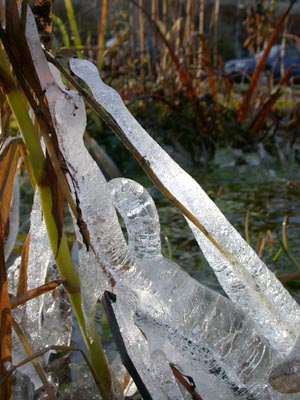
ice, ice baby
... when going for a walk at lunchtime, always take your binoculars with you.
Today, I had my camera with me but no bins - a terrible mistake. On a post-lunch potter around, Mark and I were watching birds at the feeders by the pond. There was a chorus of high-pitched alarm calls when the gaggle of Great, Coal and Blue Tits scattered - a male Sparrowhawk buzzed them and, having failed to catch anything, went off to sit in a tree.
Now the small birds knew he was there, there was probably no point in making another hunting attempt anytime soon, so the Sparrowhawk went off to the next pond (about 30m away) for a bath (yes, even in cold weather, most birds bathe every day - which is more than can be said for most humans).
Under normal weather conditions, that would have been fine, except the pond was frozen. The hawk seemed unable to comprehend this. From a distance, we watched him fly from one edge of the pond to the other, baffled by the lack of water at either.
Though it was a really interesting piece of bird behaviour, it would have been so much more enjoyable if we'd been able to see properly...
Grrrrr.
photo taken with Nikon Coolpix 995
Subscribe to:
Posts (Atom)