Sunday, May 02, 2004
The Drinker
I'm informed that the furry caterpillar I saw at Woodwalton this morning is that of The Drinker moth.

What's in my CD player: Is A Woman - Lambchop
Show me more:
caterpillar,
the drinker,
Woodwalton Fen
Washes waders
Spent a large part of yesterday afternoon/early evening on the washes. Spring wader passage seems to be at its peak so far, which is good 'cause we didn't really have any at all last year! Bar-tailed Godwit, Grey Plover, Sanderling, Little Ringed Plover and Greenshank have all been seen in the past week - not bad for an inland area.
We were just about to go home when Steve called "Temminck's Stint - flying along the bank, past the Shelduck, past the Mute Swans, over the drove - now!" He ID'd it on tail pattern - all white with a black central stripe. Pretty impressive.
Unfortunately, it's such a big area that it was nigh-on impossible to get onto a titchy wader flying hell-for-leather. I saw it as it flew over the drove, but didn't get anything on it at all - bugger!
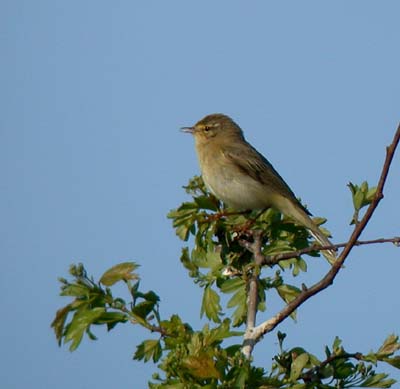
Had a phone call this morning about "four or five Wood Warblers singing at Woodwalton Fen". In the PBC area, that's definitely worth checking out, since the species is only a rare migrant, and I neeeeeeeeeeeeeed it.
Sadly, by the time a small group of us had arrived, there was no sign of them. Actually, "four or five" in a small area does sound a little odd, since it's practically a vagrant to this area and they were "doing that trilling call" - I thought Wood Warbler's call was a bit like Bullfinch? Anyway, it's not the end of the world... There was the usual array of warblers, including Grasshopper and Garden Warblers. So not entirely wasted.
Show me more:
dandelion,
Nene Washes,
Woodwalton Fen
Saturday, May 01, 2004
No Red-rump
Another trip to Ferry Meadows. Not a lot about, though I heard (and saw) my first Garden Warblers of the year, which is always nice. For me, their song compares favourably with Nightingale, and they're not featureless and boring...
I was really hoping for a Red-rumped Swallow (they seem to be everywhere else, so why not Peterborough?), but drew a blank, though there were loads of House Martins zipping about. Don Gardener and Matt Webb saw six Arctic Terns but I didn't.
What's in my CD player: Feast Of Wire - Calexico
I was really hoping for a Red-rumped Swallow (they seem to be everywhere else, so why not Peterborough?), but drew a blank, though there were loads of House Martins zipping about. Don Gardener and Matt Webb saw six Arctic Terns but I didn't.
Show me more:
Ferry Meadows,
garden warbler
Monday, April 26, 2004
No more Hoopoe but time for a Dotterel?
Went to Stibbington again at lunchtime to look for the Hoopoe. No joy. There was a fantastic field full of dandelions next to the sewage works, though... looked great for Linnet and Goldfinch.
I think it's time to start looking for Dotterel in peafields.
What's in my CD player: - Hail To The Thief - Radiohead
I think it's time to start looking for Dotterel in peafields.
Show me more:
Stibbington
Sunday, April 25, 2004
Back to earth at Ferry Meadows
After the morning's excitement, I went to Ferry Meadows again this afternoon. A bit stupid of me really, since it's so busy on sunny weekends.
Anyway, I enjoyed the walk and took some not-too-bad photos, and watched some interesting interaction between a Sedge Warbler and a Whitethroat. On the long walk round Gunwade Lake, there were plenty of fish-wielding Common Terns and some Pied Wagtails on the water's edge, plus one smart male Yellow Wagtail. But most definitely no White Wagtails.
Show me more:
Ferry Meadows,
grey heron,
pied wagtail
"Good morning. Have you just woken up?"
I was rudely awoken from my sleep this morning by my mobile phone. I didn't recognise the number. My first dozy thoughts were a) is it Monday and should I be at work? and b) it'll be someone trying to flog me something. Fortunately, I answered, for it was Martin Coates telling me that there was a Hoopoe at Stibbington. That was enough to get even me out of bed on a Sunday morning, so I woke up a bit and went to see it.
By the time I'd found my way there, a few other birders were already on the scene, including its finder, Brian Stone (he found another one at Elton Furze last year but it vanished and wasn't seen again). The bird was last seen poking around on the edge of an unmade track.
Of course, Hoopoes are famous for feeding on lawns belonging to vicars, and Stibbington Hall, just around the corner, had what we considered a highly attractive lawn, ideal for a hungry visiting Hoopoe. It obviously disagreed, because it popped up again in its original position and we all had a good eyeful until it flopped away.
Most people left at this point, but a few of us decided we might as well wait, since we were there now, and our patience paid off. The Hoopoe returned and seemed happy to feed quite close to where we were. Though it was scared off twice by dog walkers and a Magpie, it always came back to the same spot, and the last I saw of it was when it trotted off round the corner and out of sight.
My first Hoopoe in the PBC area - what a fantastic bird! I got some OK photos of it, which you can see at the top of this post and also here.
Show me more:
hoopoe,
Stibbington
Saturday, April 24, 2004
Ferry Meadows Country Park

Willow Warbler at Coney Meadow
Another post-work visit to Ferry Meadows CP. I headed for Coney Meadow again since the park was still fairly busy.
If last Friday was the day of the Willow Warbler, this week it was Reed Buntings which were singing all over the place. At least five males sang in stereo within a small area of hawthorn scrub. I tend to think of them as inhabitants of fen, rather than scrub, but I think they know what they're doing.
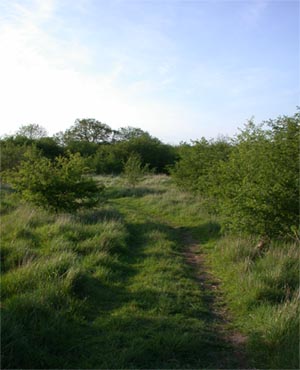
There were two male Whitethroats duelling among the brambles, too. I tried for ages to get photos of one of them, but gave up playing cat-and-mouse after a while... Nice to see them back, though.

Coney Meadow
What else was about...? About ten Common Terns were around Overton Lake, and it was interesting to see that two of them had BTO-type metal rings on their right legs.

Green Woodpecker at Coney Meadow
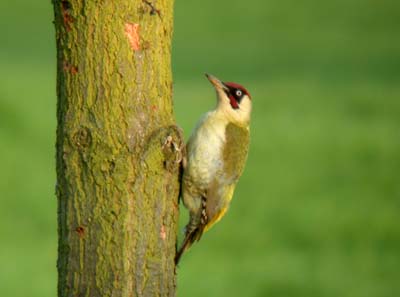
A Green Woodpecker was very vocal along a line of oaks nearby. I finally caught up with him when he flew to an isolated tree in the middle of the meadow, and I got a half-decent photo! Green Woody is one of my favourite species. Very charismatic.
I was hoping for a repeat of last week's Wheatear, which I now believe was of the 'Greenland' race leucorhoa. That's a mega-migrant for you. Anyway, there wasn't one, but I did finally see the Pink-footed Goose that hangs about with the feral Greylag flock. And I got a lovely pic of it, too...
The Cormorants were on the Overton Lake island, as usual.
Show me more:
cormorant,
Ferry Meadows,
green woodpecker,
pink-footed goose,
willow warbler
Monday, April 19, 2004
Grasshopper Warbler
Went out to Castor Hanglands at lunchtime to bag my first Grasshopper Warbler of the year. It was distant, but it'll do for now. It looked like it ought to be a good day for a fly-over raptor, but we didn't see any.
What's in my CD player: Deserter's Songs - Mercury Rev
Show me more:
Castor Hanglands,
grasshopper warbler
Saturday, April 17, 2004
It's A Wonderful Life
I meant to get up early this morning but I stayed in bed until 07:15. Lazy. I drove to Eldernell in the hope of seeing a Ring Ouzel. It was a lovely morning, but there were none there, and no Wheatears either. Oh well. You can't have everything.
Instead I concentrated my efforts on trying to digiscope singing birds. I hoped they'd be sitting fairly still, but it was the usual story of birds buggering off just when I was ready to take a picture. I was all set to get what I thought would be some fantastic pics of a singing male Blackcap, but every time I pressed the shutter, he was facing away from me! Finally, I got one half-decent image.
I don't mind. Fortunately, the Nene Washes is the kind of place where you can return, having seen nothing, and not feel too hard done by. Some of the best birds were by the car as I arrived: a Barn Owl floated by over the meadows, with Black-headed Gulls in close attendance (but keeping a safe distance). By the sluice gate on Morton's Leam, a pair of Pied Wagtails were a'courting. He was fervently bowing up and down, while she crouched down before seeing him off with a warning wave of the bill.
Show me more:
blackcap,
Nene Washes
Friday, April 16, 2004
Spotshank and Wheateater, and rediscovery of Sparklehorse
It's been an interesting day. It didn't start promisingly, since the Ring Ouzel wasn't seen again after the early morning. But we had a phone call from Will Bowell mid-morning to say that Josh Jones had found a nearly summer-plumaged Spotted Redshank at the bizarrely-named Grummit's Scrape.
Managed to get out at lunchtime (first piece of lunchtime twitching since passing driving test). When Dr Weedon and I turned up, there was not a lot to be seen, and certainly no Spotshank. We were despondent and on the verge of leaving the hide when we heard a 'chewit!' Soon enough, the dusky beauty popped out from the edge of the scrape and it showed fairly well until we left.
I took some hasty pics but they're abysmal. If you want to see them, click here and here. But Josh's are much better.
After work I went down to Ferry Meadows, since it was such a nice evening. Had a wander around the scrubby parts of Coney Meadow, where I attempted to digiscope singing Willow Warblers. I had a couple of near-misses: click here to see one. The WWs were fantastic. It seemed like there was one singing from the top of nearly every hawthorn bush. Of course, they all dived for cover as soon as I thought I could get a picture of them...
As I walked out of the scrub towards Lynch Lake, I glimpsed something on top of a post, which turned into a smart male Wheatear. He vanished initially, until I rediscovered him lurking by the narrow-gauge railway. I got a half-decent photo (after some sharpening). Unfortunately, digiscoping was curtailed because of some chav wantonly kicking a football between me and the bird, flushing it. Oh well...
I'd forgotten how much I love Sparklehorse. Highly recommended.
Show me more:
Baston and Langtoft,
Ferry Meadows,
wheatear
Thursday, April 15, 2004
Maxey GP
This afternoon I went out for a drive to Maxey GP. Not terribly exciting... two smashing male Yellow Wagtails, a Shelduck, about 50 Sand Martins, a Green Sandpiper, a singing Willow Warbler...
Much more interesting was the Cuckoo that flew in front of the car near Helpston. But extremely annoying was the Little Gulls at Ferry Meadows CP at 15:00! All gone by 17:00. There seems to have been a bit of a movement today.
Today's favourite news stories:
Young female chimps upstage males
Pizza cone takes a slice of food-on-the-move action
What's in my CD player: Mwng - Super Furry Animals
Much more interesting was the Cuckoo that flew in front of the car near Helpston. But extremely annoying was the Little Gulls at Ferry Meadows CP at 15:00! All gone by 17:00. There seems to have been a bit of a movement today.
Today's favourite news stories:
Young female chimps upstage males
Pizza cone takes a slice of food-on-the-move action
Show me more:
Ferry Meadows,
Maxey
Wednesday, April 14, 2004
What is this blog about?
I feel obliged, should there be anyone else reading this, to explain what birding is.
It's probably better known as birdwatching, the act of watching birds. Yes, blokes, you can make jokes like "I like watching birds but not the ones with feathers! HA HA HA!" but we've heard them all before and they still aren't funny.
A good phrase to summarise what watching birds is about is used by the RSPB for one of their campaigns. It's: "Aren't Birds Brilliant!" Birding doesn't have to involve vast numbers of birds, or a rare or spectacularly-coloured species, or ones with beautiful songs, though it can be any of those. It could be something as simple as watching a Starling probing for leatherjackets in a lawn, or a Chiffchaff, newly-arrived from Africa, picking its way through a hawthorn bush. Or a House Sparrow building a nest under roof tiles. These are all fairly mundane things that you can see on the way to work every morning.
I find watching birds go about their daily business fascinating. There is so much about them that we don't fully understand. Actually, there are plenty of things that we have no idea about. How do birds navigate their way around the world? Why do some species agitate ants' nests and then wait for the ants to crawl all over them? How do birds tell each other apart? We may never know for sure.
On the other hand, spectacular birds, or ones that do odd things, are extremely interesting. One of my favourite sounds is the 'drumming' of the Snipe. It's a small wading bird with a long, sensitive, slightly flexible bill which it uses to feed in soft ground or mud. The Snipe 'drums' by flying high up in a display flight, then diving earthward and fanning out its outer tail feathers. They vibrate, making an audible humming noise.
Anyway, what I'm trying to get at is that birds are fascinating beings. They are constantly doing things beyond our comprehension. They are all around us. They come in many different shapes, sizes and colours, and are adapted to just about any environment and extreme condition you can think of.
Compare penguins (ice and intense cold. Incubates its egg/chick on its specially adapted feet) and sandgrouse (desert and heat. The males carry water on their breast feathers to their young at the nest). Birds are immensely strong (eg. Arctic Terns spending 'our' winter in the southern hemisphere, then breeding in northern Britain; tiny warblers migrating year after year to and from Africa), and at the same time delicate and beautiful (look at the same warbler up close and you wouldn't think it capable of such a feat).
In short, birds enrich our lives and my life is improved immeasurably by them.
Here are my favourite BBC News stories of the day:
European men outstrip Americans
Nasa helps its feathered friends
What's in my CD player: Awcmon - Lambchop
It's probably better known as birdwatching, the act of watching birds. Yes, blokes, you can make jokes like "I like watching birds but not the ones with feathers! HA HA HA!" but we've heard them all before and they still aren't funny.
A good phrase to summarise what watching birds is about is used by the RSPB for one of their campaigns. It's: "Aren't Birds Brilliant!" Birding doesn't have to involve vast numbers of birds, or a rare or spectacularly-coloured species, or ones with beautiful songs, though it can be any of those. It could be something as simple as watching a Starling probing for leatherjackets in a lawn, or a Chiffchaff, newly-arrived from Africa, picking its way through a hawthorn bush. Or a House Sparrow building a nest under roof tiles. These are all fairly mundane things that you can see on the way to work every morning.
I find watching birds go about their daily business fascinating. There is so much about them that we don't fully understand. Actually, there are plenty of things that we have no idea about. How do birds navigate their way around the world? Why do some species agitate ants' nests and then wait for the ants to crawl all over them? How do birds tell each other apart? We may never know for sure.
On the other hand, spectacular birds, or ones that do odd things, are extremely interesting. One of my favourite sounds is the 'drumming' of the Snipe. It's a small wading bird with a long, sensitive, slightly flexible bill which it uses to feed in soft ground or mud. The Snipe 'drums' by flying high up in a display flight, then diving earthward and fanning out its outer tail feathers. They vibrate, making an audible humming noise.
Anyway, what I'm trying to get at is that birds are fascinating beings. They are constantly doing things beyond our comprehension. They are all around us. They come in many different shapes, sizes and colours, and are adapted to just about any environment and extreme condition you can think of.
Compare penguins (ice and intense cold. Incubates its egg/chick on its specially adapted feet) and sandgrouse (desert and heat. The males carry water on their breast feathers to their young at the nest). Birds are immensely strong (eg. Arctic Terns spending 'our' winter in the southern hemisphere, then breeding in northern Britain; tiny warblers migrating year after year to and from Africa), and at the same time delicate and beautiful (look at the same warbler up close and you wouldn't think it capable of such a feat).
In short, birds enrich our lives and my life is improved immeasurably by them.
Here are my favourite BBC News stories of the day:
European men outstrip Americans
Nasa helps its feathered friends
Monday, April 12, 2004
Meadow Pipit, Nene Washes
I think this is my best photo to date. I was just giving up on trying to digiscope Meadow Pipits when this one perched on a fencepost for a few minutes.
There's always the 'do I or don't I try to digiscope it?' quandary - I seem to spend half my time carefully moving into position, only for the bird to fly off at the critical moment. Fortunately, it stayed put for several minutes and the meadow made a good background. They're very under-rated birds. I think it must have been watching flies above its head.
Saturday, April 03, 2004
Ringing at Farcet Fen
Chris and I went down to Steve Dudley's garden with the aim of trapping and colour-ringing some House and Tree Sparrows. Steve had counted a maximum of nine Treeps in the garden at any one time, so it was a bit of a surprise to catch 13! Over the next few weeks, he counted another nine which had escaped the nets, making a total of at least 22 individuals.
The House and Tree Sparrows we caught were fitted with a standard BTO metal ring on the right leg, and a red plastic ring on the left, as part of a research project into sparrows in the Fens. Hopefully we'll be able to do a return visit in the autumn when there are plenty of juveniles in the garden.
Other birds caught included Song Thrush, Reed Bunting, Yellowhammer, Chaffinch (at least one of which was a big, long-winged bird of continental origin) and Dunnock. It was very interesting to see ringing in an entirely different habitat and very nice not to have to wear wellies/waterproof trousers/waxed jacket...
The House and Tree Sparrows we caught were fitted with a standard BTO metal ring on the right leg, and a red plastic ring on the left, as part of a research project into sparrows in the Fens. Hopefully we'll be able to do a return visit in the autumn when there are plenty of juveniles in the garden.
Other birds caught included Song Thrush, Reed Bunting, Yellowhammer, Chaffinch (at least one of which was a big, long-winged bird of continental origin) and Dunnock. It was very interesting to see ringing in an entirely different habitat and very nice not to have to wear wellies/waterproof trousers/waxed jacket...
Saturday, February 21, 2004
Ferry Meadows
Lesser Redpolls (Carduelis cabaret) can be hard to pin down in the Peterborough area, so I was happy to find a small flock feeding in the alders on the north bank of the River Nene, near Bluebell Bridge. They spent quite a lot of time feeding on fallen alder cones on the ground.
Friday, January 30, 2004
Glaucous Gull, Prior's Fen
Believe it or not, this Glaucous Gull was actually *cough* a lifer for me. I just haven't ever gone out of my way to look for gulls in the past, but we made a special flying visit to Prior's Fen.
I hate gulls, but I hate Prior's even more.
Sunday, January 04, 2004
American Robin, Grimsby
Occasionally, it is nice to escape from the Peterborough Bird Club area and experience the illicit thrills of dirty twitching.
The American Robin at Grimsby, Lincolnshire, deserved a visit so I blagged a lift there with Steve Dudley and borrowed a digiscoping adaptor for the day. The picture above goes to prove that even I can take half-decent pictures of brightly-coloured birds at close range in sunny conditions.
Wednesday, December 03, 2003
The Gambia: Nov 28 - Dec 2, 2003
I was lucky enough to visit The Gambia with The Gambia Experience at the end of November 2003. Though I didn't really attempt any bird photography, I got some other pics which you can see here.

After coffee at Lamin Lodge, we set out on our 'Birds and Breakfast' excursion. This is a view from a dugout canoe on a tributary of the River Gambia at dawn. We moved silently downriver.
As we glided past the mangrove roots, we could see oysters (an important crop which is harvested by women), lots of tiny crabs and the occasional fish. Plenty of birds in the branches, as well as waders poking around in the mud.

I really wanted to see more bee-eater species after enjoying European Bee-eater (Merops apiaster) in Spain and Lesbos. The boat was a great way to get close to several species, including Little Bee-eater (Merops pusillus)(above, camera handheld). After about 90 minutes on the boat, our backsides were all numb and we returned to the Lodge for breakfast...

A view of Lamin Lodge from the water. It stands on stilts over the water (or mud, depending on the tide). The mangroves are an important habitat for all kinds of wildlife. You can enjoy the view over the top of the mangroves while having breakfast. Birds visible included more Little Bee-eaters, a Bearded Barbet (Lybius dubius) and Red-billed Hornbill (Tockus erythrorhynchus).
We weren't the only ones ready for some food, though... As we sat down to brekkers, we were joined by a group of Green Vervet monkeys, who were very naughty and stole a sugar bowl as well as food from everyone's plates. I suffered the loss of two pancakes and some honey.

It was time for another cack-handed attempt at bird photography...
Pied Kingfisher (Ceryle rudis) was the most common member of its family that we saw on our trip (we also saw one Malachite Kingfisher, Alcedo cristata). We frequently saw Pieds either perched on mangroves or hovering over the water. This one stayed still for long enough for me to attempt a photo.

One of the great things about The Gambia is that you can see a huge variety of birds wherever you go, even on thhe way to and from the airport. However, there are also some special reserves to visit. Abuko Game Reserve is pretty much the epitome of African jungle that you imagine. Up to 20 crocodiles are supposed to inhabit its pools,
though we didn't see any.

The best bird was definitely Violet Turaco (Musophaga violacea), which performed beautifully just outside the hide - a beast and a half!

Like in other parts of the world, the forest in The Gambia is threatened, though it was good to see that steps are being taken to protect it. Makasutu ('holy forest') was a fabulous place to visit. You can also stay in its luxury lodges by the Mandina Bolong [river]. After a guided stroll through the forest, we arrived at the lodges (complete with The Gambia's biggest swimming pool!) and admired the view - what a place for a holiday!

Quite a contrast from the bustling Kotu Beach area where most visitors to The Gambia stay. No cars, no bumsters, no hassle, no beach - just the river and the birds and insects around it. Each lodge has its own dugout. The rivers and creeks in The Gambia are central to life there.

We went to meet the local Marabou (witch-doctor), but he was out. So we met his extended family instead at their hut. In The Gambia, you need to be careful not to offend when taking people's photos (they believe it steals their soul). But if you ask nicely, there's usually no problem.

We also encountered some other forest inhabitants... Muscovy Ducks get everywhere! It was time for lunch...

Dancing, singing and drumming from the Jola tribe was on the agenda after lunch, though fortunately for us Brits, audience participation was not compulsory.

We visited a school at Yakanu to bestow our precious gifts of pens, pencils, books and paper on the pupils. As you can see from the banner above the window, Desperate Dan has indeed made it as far as The Gambia! You can see hand-painted walls everywhere.

Unfortunately, the Tonyfelin Welsh Baptist Church Computer Lab was not yet up and running, but at least they had some computers (even if they didn't work...). We met some pupils and they seemed very excited, especially when we could show them their photos on the digital camera's monitor.

Unlike many schools in the UK, the pupils were well turned-out, polite and enthusiastic! These children have just started school. They're the lucky ones whose parents can afford to pay.


Everywhere we went, Gambians of all ages were pleased to meet us. Life is hard for many people, however. Though many Gambians have mobile phones and Internet cafes are abundant, lots of people still rely on the land to make a living.
We took a trip out through the bush in a huge four-wheel-drive truck to see the bush. Much more enjoyable than an air-conditioned bus - you can feel the breeze through your hair, get covered in dust, and get much better views of the countryside, people and birds.
We visited a compound - a Gambian house with yard and outhouses - as part of our trip on the truck. Everyone was very friendly and eager to relieve us of any surplus pens or paper we had! The girls in the picture below attend an Islamic school.

Though it all seemed very basic and rustic, with chickens running around, our illusions were shattered when one of the villagers' mobile phones burst into life...

Our guide for most of the week, Mr President, runs a restaurant and was after a chicken in order to become self-sufficient in poultry. He was given one, free of charge, at the compound.
The Gambia is a country full of new sights, sounds and tastes. Another visit was made to a palm plantation, where palm sap is harvested. The sap drips off into specially-positioned plastic bottles, where it ferments in the sun. Result = palm wine. You can't bring it home because it ferments and ferments and ferments and an explosion could result.
Palm wine is distilled to produce 'fire-water' - a lethal spirit which you can take home... In the picture, Trevor the journalist is about to lose his passport as he tries to climb a palm tree in search of alcohol.

Our trip through the bush took in visits to a school and a compound and ended up on this beach, where we had another superb lunch of freshly-cooked chicken, fish, prawns, rice and vegetables. New birds for the list here were Turnstone (Arenaria interpres), Sanderling (Calidris alba) and Pink-backed Pelican (Pelecanus rufescens).

A good way to finish the trip. If you counted all the Woodland Kingfishers on bottles of JulBrew, it would surely be The Gambia's most common bird. Most Gambians are Muslim and therefore teetotal.

LIST
Small but perfectly-formed. This wasn't strictly a birding trip so I missed lots. The hyperlinks lead to pics of the species at Nigel Blake's website.
Long-tailed Cormorant
Pink-backed Pelican
Cattle Egret
Black Egret
Western Reef Heron
Intermediate Egret
Great White Egret
Purple Heron
Grey Heron
Hamerkop
Black Kite
Long-crested Eagle
Palm-nut Vulture
Hooded Vulture
African Harrier-hawk
Shikra
Lizard Buzzard
Osprey
Senegal Thick-knee
Ringed Plover
Grey Plover
Spur-winged Plover
Sanderling
Bar-tailed Godwit
Whimbrel
Redshank
Greenshank
Common Sandpiper
Turnstone
Pomarine Skua
Lesser Black-backed Gull
Grey-headed Gull
Gull-billed Tern
Caspian Tern
Royal Tern
Sandwich Tern
Common Tern
Speckled Pigeon
Laughing Dove
African Mourning Dove
Vinaceous Dove
Red-eyed Dove
Senegal Parrot
Rose-ringed Parakeet
Violet Turaco
Western Grey Plantain-eater
Senegal Coucal
Pearl-spotted Owlet
Little Swift
Malachite Kingfisher
Blue-breasted Kingfisher
Pied Kingfisher
Little Bee-eater
Rufous-crowned Roller
Blue-bellied Roller
Red-billed Hornbill
African Pied Hornbill
Bearded Barbet
Grey Woodpecker
Red-chested Swallow
Common Bulbul
Common Wattle-eye
Brown Babbler
Mouse-brown Sunbird
Beautiful Sunbird
Yellow-crowned Gonolek
Piapiac
Pied Crow
Long-tailed Glossy Starling
House Sparrow
Grey-headed Sparrow
White-billed Buffalo-weaver
Village Weaver
Northern Red Bishop
Red-billed Firefinch
Bronze Mannikin
Pin-tailed Whydah
LINKS
The Gambia Experience
Banjul weather
Nigel Blake's superb Gambian bird photos
AOL's page about The Gambia
Bird Studies Canada's list of Gambian bird links
A Field Guide to the Birds of The Gambia and Senegal
BOU Checklist - The Birds of The Gambia
After coffee at Lamin Lodge, we set out on our 'Birds and Breakfast' excursion. This is a view from a dugout canoe on a tributary of the River Gambia at dawn. We moved silently downriver.
As we glided past the mangrove roots, we could see oysters (an important crop which is harvested by women), lots of tiny crabs and the occasional fish. Plenty of birds in the branches, as well as waders poking around in the mud.
I really wanted to see more bee-eater species after enjoying European Bee-eater (Merops apiaster) in Spain and Lesbos. The boat was a great way to get close to several species, including Little Bee-eater (Merops pusillus)(above, camera handheld). After about 90 minutes on the boat, our backsides were all numb and we returned to the Lodge for breakfast...
A view of Lamin Lodge from the water. It stands on stilts over the water (or mud, depending on the tide). The mangroves are an important habitat for all kinds of wildlife. You can enjoy the view over the top of the mangroves while having breakfast. Birds visible included more Little Bee-eaters, a Bearded Barbet (Lybius dubius) and Red-billed Hornbill (Tockus erythrorhynchus).
We weren't the only ones ready for some food, though... As we sat down to brekkers, we were joined by a group of Green Vervet monkeys, who were very naughty and stole a sugar bowl as well as food from everyone's plates. I suffered the loss of two pancakes and some honey.
It was time for another cack-handed attempt at bird photography...
Pied Kingfisher (Ceryle rudis) was the most common member of its family that we saw on our trip (we also saw one Malachite Kingfisher, Alcedo cristata). We frequently saw Pieds either perched on mangroves or hovering over the water. This one stayed still for long enough for me to attempt a photo.
One of the great things about The Gambia is that you can see a huge variety of birds wherever you go, even on thhe way to and from the airport. However, there are also some special reserves to visit. Abuko Game Reserve is pretty much the epitome of African jungle that you imagine. Up to 20 crocodiles are supposed to inhabit its pools,
though we didn't see any.
The best bird was definitely Violet Turaco (Musophaga violacea), which performed beautifully just outside the hide - a beast and a half!
Like in other parts of the world, the forest in The Gambia is threatened, though it was good to see that steps are being taken to protect it. Makasutu ('holy forest') was a fabulous place to visit. You can also stay in its luxury lodges by the Mandina Bolong [river]. After a guided stroll through the forest, we arrived at the lodges (complete with The Gambia's biggest swimming pool!) and admired the view - what a place for a holiday!
Quite a contrast from the bustling Kotu Beach area where most visitors to The Gambia stay. No cars, no bumsters, no hassle, no beach - just the river and the birds and insects around it. Each lodge has its own dugout. The rivers and creeks in The Gambia are central to life there.
We went to meet the local Marabou (witch-doctor), but he was out. So we met his extended family instead at their hut. In The Gambia, you need to be careful not to offend when taking people's photos (they believe it steals their soul). But if you ask nicely, there's usually no problem.
We also encountered some other forest inhabitants... Muscovy Ducks get everywhere! It was time for lunch...
Dancing, singing and drumming from the Jola tribe was on the agenda after lunch, though fortunately for us Brits, audience participation was not compulsory.
We visited a school at Yakanu to bestow our precious gifts of pens, pencils, books and paper on the pupils. As you can see from the banner above the window, Desperate Dan has indeed made it as far as The Gambia! You can see hand-painted walls everywhere.
Unfortunately, the Tonyfelin Welsh Baptist Church Computer Lab was not yet up and running, but at least they had some computers (even if they didn't work...). We met some pupils and they seemed very excited, especially when we could show them their photos on the digital camera's monitor.
Unlike many schools in the UK, the pupils were well turned-out, polite and enthusiastic! These children have just started school. They're the lucky ones whose parents can afford to pay.
Everywhere we went, Gambians of all ages were pleased to meet us. Life is hard for many people, however. Though many Gambians have mobile phones and Internet cafes are abundant, lots of people still rely on the land to make a living.
We took a trip out through the bush in a huge four-wheel-drive truck to see the bush. Much more enjoyable than an air-conditioned bus - you can feel the breeze through your hair, get covered in dust, and get much better views of the countryside, people and birds.
We visited a compound - a Gambian house with yard and outhouses - as part of our trip on the truck. Everyone was very friendly and eager to relieve us of any surplus pens or paper we had! The girls in the picture below attend an Islamic school.
Though it all seemed very basic and rustic, with chickens running around, our illusions were shattered when one of the villagers' mobile phones burst into life...
Our guide for most of the week, Mr President, runs a restaurant and was after a chicken in order to become self-sufficient in poultry. He was given one, free of charge, at the compound.
The Gambia is a country full of new sights, sounds and tastes. Another visit was made to a palm plantation, where palm sap is harvested. The sap drips off into specially-positioned plastic bottles, where it ferments in the sun. Result = palm wine. You can't bring it home because it ferments and ferments and ferments and an explosion could result.
Palm wine is distilled to produce 'fire-water' - a lethal spirit which you can take home... In the picture, Trevor the journalist is about to lose his passport as he tries to climb a palm tree in search of alcohol.
Our trip through the bush took in visits to a school and a compound and ended up on this beach, where we had another superb lunch of freshly-cooked chicken, fish, prawns, rice and vegetables. New birds for the list here were Turnstone (Arenaria interpres), Sanderling (Calidris alba) and Pink-backed Pelican (Pelecanus rufescens).
A good way to finish the trip. If you counted all the Woodland Kingfishers on bottles of JulBrew, it would surely be The Gambia's most common bird. Most Gambians are Muslim and therefore teetotal.
LIST
Small but perfectly-formed. This wasn't strictly a birding trip so I missed lots. The hyperlinks lead to pics of the species at Nigel Blake's website.
Long-tailed Cormorant
Pink-backed Pelican
Cattle Egret
Black Egret
Western Reef Heron
Intermediate Egret
Great White Egret
Purple Heron
Grey Heron
Hamerkop
Black Kite
Long-crested Eagle
Palm-nut Vulture
Hooded Vulture
African Harrier-hawk
Shikra
Lizard Buzzard
Osprey
Senegal Thick-knee
Ringed Plover
Grey Plover
Spur-winged Plover
Sanderling
Bar-tailed Godwit
Whimbrel
Redshank
Greenshank
Common Sandpiper
Turnstone
Pomarine Skua
Lesser Black-backed Gull
Grey-headed Gull
Gull-billed Tern
Caspian Tern
Royal Tern
Sandwich Tern
Common Tern
Speckled Pigeon
Laughing Dove
African Mourning Dove
Vinaceous Dove
Red-eyed Dove
Senegal Parrot
Rose-ringed Parakeet
Violet Turaco
Western Grey Plantain-eater
Senegal Coucal
Pearl-spotted Owlet
Little Swift
Malachite Kingfisher
Blue-breasted Kingfisher
Pied Kingfisher
Little Bee-eater
Rufous-crowned Roller
Blue-bellied Roller
Red-billed Hornbill
African Pied Hornbill
Bearded Barbet
Grey Woodpecker
Red-chested Swallow
Common Bulbul
Common Wattle-eye
Brown Babbler
Mouse-brown Sunbird
Beautiful Sunbird
Yellow-crowned Gonolek
Piapiac
Pied Crow
Long-tailed Glossy Starling
House Sparrow
Grey-headed Sparrow
White-billed Buffalo-weaver
Village Weaver
Northern Red Bishop
Red-billed Firefinch
Bronze Mannikin
Pin-tailed Whydah
LINKS
The Gambia Experience
Banjul weather
Nigel Blake's superb Gambian bird photos
AOL's page about The Gambia
Bird Studies Canada's list of Gambian bird links
A Field Guide to the Birds of The Gambia and Senegal
BOU Checklist - The Birds of The Gambia
Show me more:
green vervet,
little bee-eater,
muscovy duck,
people,
pied kingfisher,
The Gambia
Subscribe to:
Posts (Atom)