Sunday, April 16, 2006

Bedford Purlieus NNR

Big, fierce-looking wood ants were much in evidence
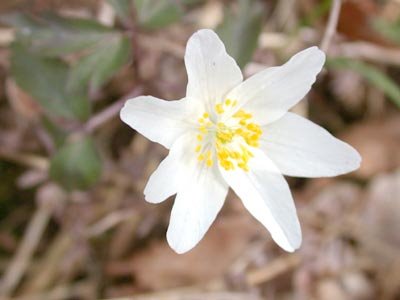
Wood Anemone, Anemone nemorosa


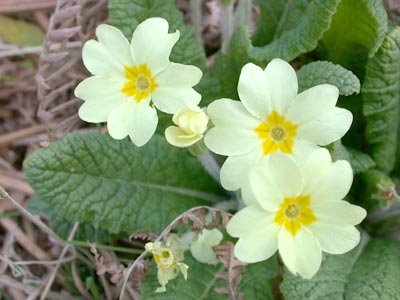
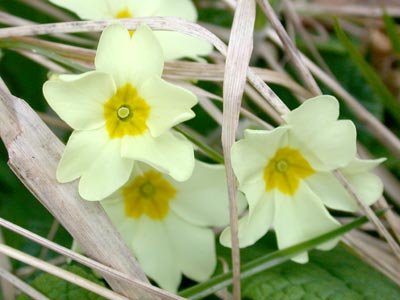
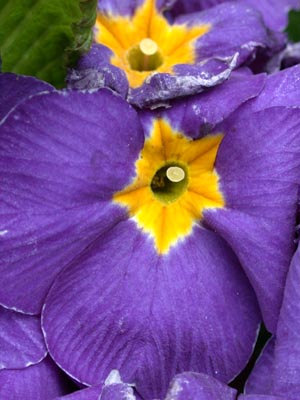
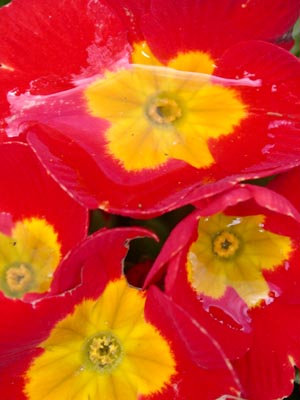
Wild Primroses, Primula vulgaris, were everywhere
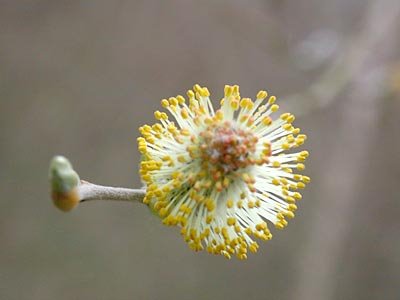
Pussy Willow, Salix discolor

photos taken with Nikon Coolpix 995

Saturday, April 15, 2006

Yellow and green


For woodland flowers, these celandines (?) grow in a rather bizarre location on the Nene Washes. Not a tree to be seen, but presumably there were some at that spot originally.

photos taken with Nikon Coolpix 995

Friday, April 14, 2006

Sheryl Crow

Good to see the folks at The Guardian are getting excited about Carrion Crows nesting just outside their window in London.

'Wanna see some pictures of Sheryl? In bed. I'm looking at at her right now, through the window, writes Sam Wollaston. She doesn't know I'm watching her. It feels a bit wrong. But not that wrong, because Sheryl is a crow. Sheryl Crow, do you see?'

'Her husband's over there on the TV aerial, watching out for her. Russell, he's called. He's lovely - sometimes he comes over and vomits into her mouth - regurgitated worms, insects, carrion.'

Read 'Watch the birdie' on the Guardian News Blog.

Thursday, April 13, 2006

Limited success

Today was a funny old day.

Mid-morning, I received a phone call from Darren to say one of his colleagues had seen a Firecrest in the gardens. At lunchtime, Mark Ward and I went to have a look for it - without much optimism, it has to be said. There's a lot of habitat for a 'crest to hide in and my previous success in refinding them has been zero.

We'd been searching in the right spot for about 15 minutes and it wasn't looking too promising.

Then, all of a sudden, the bird popped up in some shrubbery in front of us. It quickly flew up into a tall yew tree and vanished into the branches.

'S***! It's a Firecrest!'

I had a rather brief view, mainly of its backside, but got a glimpse of the eyestripe which made my heart race.

(Have a look at Steve Round's stupendous Firecrest photos)

Next, I reached into my pocket and phoned Darren's mobile.

'This person's phone is currently switched off.'

Doh! Tried again, and then his landline, but he'd gone to lunch and was uncontactable! So that was a tad annoying, to say the least.

After work, we spent an hour or so trying to relocate the Firecrest (without any joy) before heading off to Fowlmere to see the Hoopoe which was found there earlier today.

Sadly, by the time we arrived it had gone to roost in a dense hedge, and if a nice man with his scope already on it hadn't given us a look, I don't think we'd ever have been able to find it ourselves. You could see some pinky-brown bits and occasionally some black and white wing, but that was it. Just bits of Hoopoe in isolation, never the whole bird in all its glory.

It was decidedly unsatisfactory. I hope we'll manage to go for another one later this year.

Sunday, April 09, 2006

Local birding

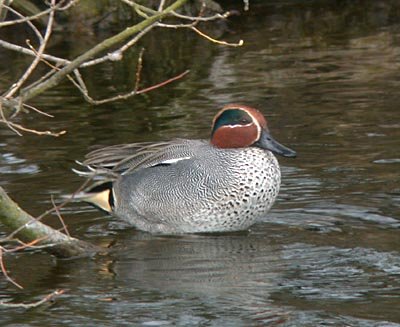
Green-winged Teal (right, front)

The above Green-winged Teal was probably the highlight of our day in the Peterborough area, today. It was first found at Woodwalton Fen NNR a couple of weeks ago but has only been visible intermittently, as the Teal flock it's hanging out with like to hide in the reeds. So that was quite lucky.

Male [Common] Teal


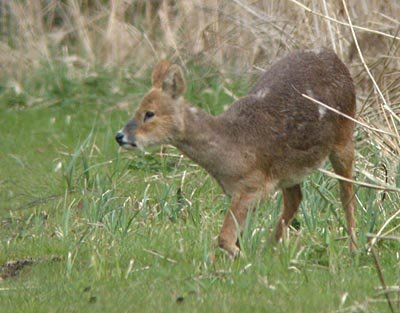
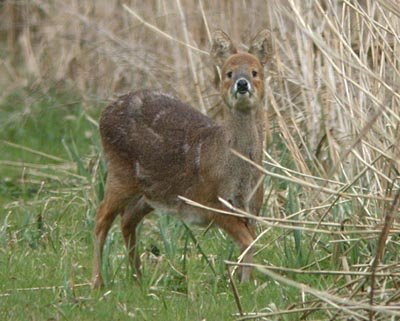
Chinese Water Deer

Chinese Water Deer are very odd-looking beasts. There's something rather teddy bear-ish about their faces. They seem to be quite tame - this one came wandering towards us.
The marks on its body are intriguing. Is it the result of fighting or just moulting? You can often see clumps of very coarse fur lying on the ground at Woodwalton - it almost looks like porcupine quills.

You can read more about them at the Deer-UK website.

We started the day at Aversley Wood - a few springy shots below.


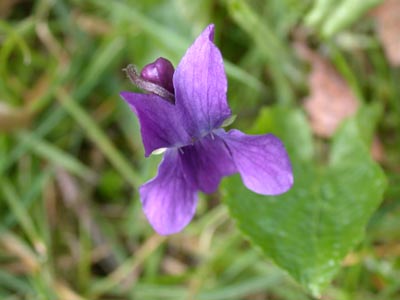
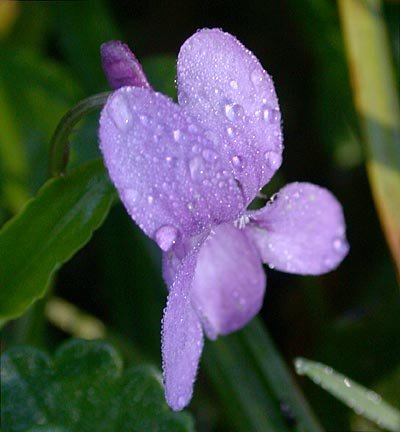
Dog-violet


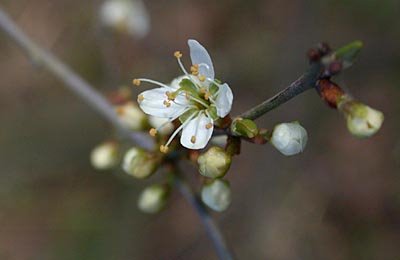
Blackthorn blossom

unidentified flowers!

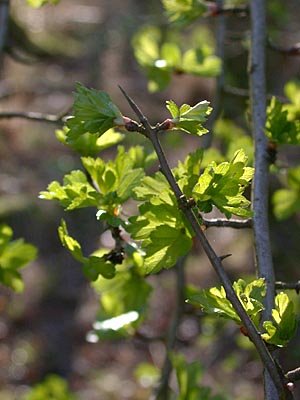
new Hawthorn leaves

digiscoped photos taken with Nikon Coolpix 995 + Leica Apo Televid 77 with 20x eyepiece

Saturday, April 08, 2006

The f** word

So, at long last, it's here. Avian influenza has reached good old Blighty.

It's good to know that the BBC's finest are on the case, issuing advice to the Great British public on how to identify the Bird Flu Top Ten - that is, the species which 'have been monitored by experts as potential importers of the virus'.

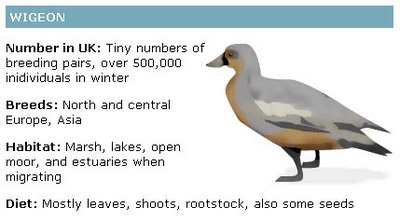
From my perspective, this page is good for one thing - providing amusement. Just look at poor old Mr Wigeon below! He does look a bit ill, doesn't he!

I can only guess that these shoddy illustrations didn't cost as much as a proper image from an image library would have done.

What use is this story? Here are the top ten birds to avoid! Better still, kill them if you can! Still, how is anyone going to be able to avoid a White-fronted Goose when the BBC is telling you they look like this? That resembles a very odd-looking Canada x Greylag hybrid, to me...
As you would expect, Charlie Moores has written something funny about f**. Read 'Bird F**' - Britain under attack...' and weep, because there almost certainly are people out there who are thinking like that.

We watched the BBC Ten O'Clock News last night. Top of the bill was bird flu and how it might have got to Britain. Bizarrely, Puffins were mentioned!

If the BBC says it, it must be true. After all, Puffins are well-known for spending their winters on the shores of the Baltic (not out at sea, far from land and other birds), in close contact with infected swans, before they return to Britain, carrying the Deadly Bird Flu with them.

I know Puffins are cute and make good television, but don't implicate the poor little fellows in bird flu when it's nothing to do with them!

Grrr!

Thursday, April 06, 2006

Bempton


Auks on the cliffs

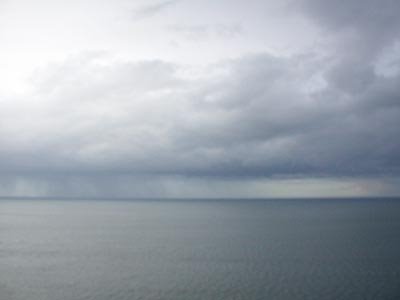
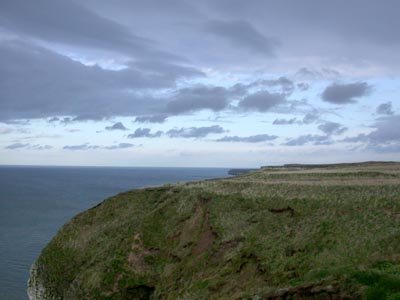
It's raining out at sea

Went to the East Riding of Yorkshire for a couple of days with my Mum. The main purpose was for family history research (which you can read about here if you have the inclination) but it would have been silly not to make a brief visit to Bempton while we were in the area.

It was a cold, windy evening and I didn't have any binoculars with me, but there were still plenty of birds around. Gannets cruised past and the cliff ledges were filled with Guillemots and Razorbills hanging onto them, while Kittiwakes and Fulmars flew by.

Can't wait to go back in about a month's time when the birds have young and it's really exciting.

photos taken with Nikon Coolpix 995

Wednesday, April 05, 2006

Flava flava


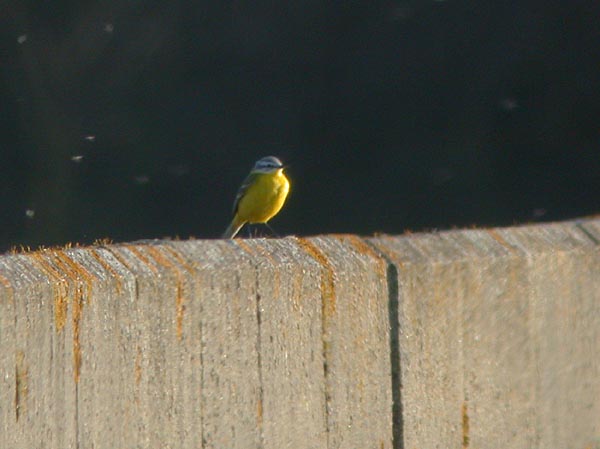
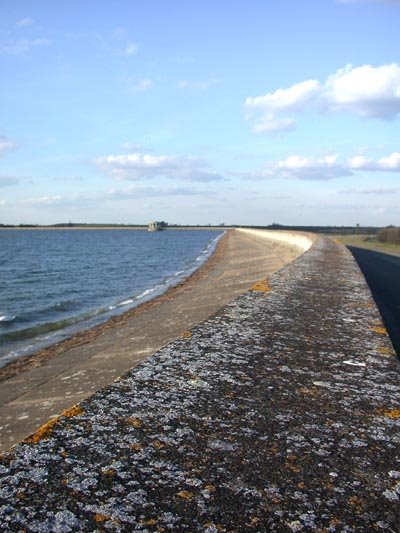
We stopped at Grafham Water on the way home tonight, to see the 'Blue-headed' Wagtail which had been present all afternoon. Here's a photo of it. It's a Yellow Wagtail of the continental race Motacilla flava flava.
There had been a hatch of flies from the water and this bird had gathered, along with a decent-sized group of other wagtails - Pied, 'White' and Grey - to enjoy something of a feeding frenzy.

It's great to see Yellow Wagtails again - they're as much a sign of spring as daffodils are.

photos taken with Nikon Coolpix 995 + Leica Apo Televid 77 with 20x eyepiece

Daffodils


I love yellow! Yellow flowers, yellow wagtails...

photos taken with Nikon Coolpix 995

Friday, March 31, 2006

More garden stuff

Bumblebee on primroses

Bluey-purple primroses

Tiny pansy-thing

photos taken with Nikon Coolpix 995

Thursday, March 30, 2006

Spring colours


Primroses

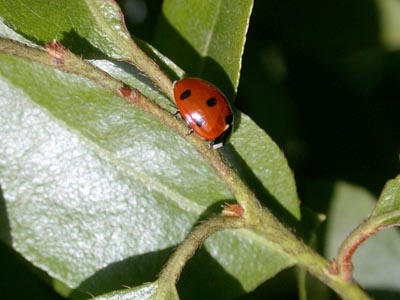
Ladybird

Daffodils

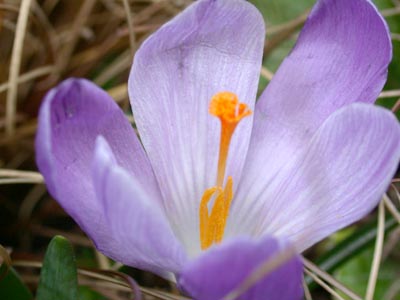
Crocus

Some things I don't know the name of

I thought this was a dog-violet to start with, but is it actually a tiny pansy?

The results of a quick wander around the gardens at lunchtime.

photos taken with Nikon Coolpix 995

Sunday, March 26, 2006

How do they do it?

9.45pm

Darren is outside in the garden, smoking. A very bad habit indeed, but it has its uses - he's hearing Redwings flying over in the dark!

I think many people associate hearing Redwings' high-pitched 'seeeep' calls with their southbound autumn migration. But tonight came as a reminder that they have to go back the other way, too.

I assumed previously that night migrants such as Redwings would pick a clear night to migrate, assuming that the stars help them plot a course, but this evening it's been drizzling heavily and the skies are 100% cloudy. How on earth are they managing to find their way?

Nobody seems quite sure.

I wonder if artificial lighting comes into it? When coming in to land at a British airport under cover of darkness, you can easily pick out street lights in built-up areas and along major routes, even from quite high up. The Europeans are much better at using energy-saving, light-pollution limiting lights.

Some links to interesting migration-themed features:

Yellowhammer


A poor portrait of a super bird. Usual moans about it being nearly dark, blowing a gale, etc...

photo taken with Nikon Coolpix 995 + Leica Apo Televid 77 with 20x eyepiece

Saturday, March 25, 2006

Nene Washes

Lapwing

Golden Plovers


Mute Swan


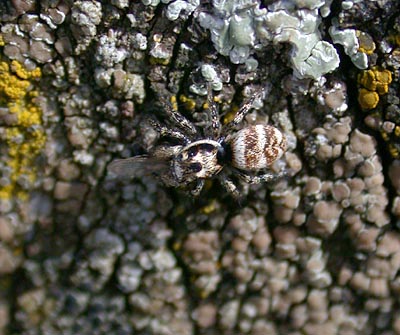
Tiny spider with even tinier fly


photos taken with Nikon Coolpix 995 + Leica Apo Televid 77 with 20x eyepiece

Thursday, March 23, 2006

Birds' bathtime


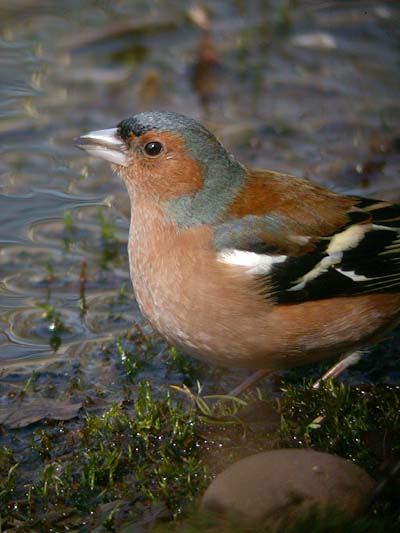
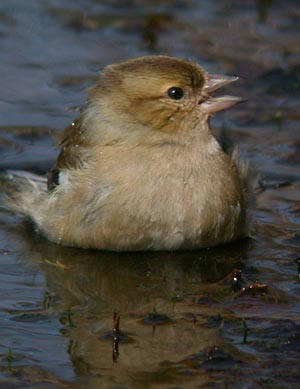
Chaffinches

Male Blackbird

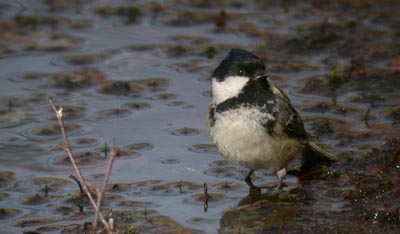
Coal Tit

Stock Dove

Bathtime at The Lodge once more. You would think that taking photos of bathing birds from a hide in bright sunshine would be a piece of cake. Not always so.

Some birds are too small and distant (tits, Siskins). Some are too big and quick and close (Stock Dove). Some move too fast (hmm... all of the above). About the only species that behaves itself in front of the camera is the humble Chaffinch.

Today was quite unusual because there were already three photographers in residence in the hide when I arrived. It looked like my planned lunchtime activities were going to be foiled by a lack of room, but it turned out OK. Which is more than can be said for most of the photos.

That said, I am very pleased with the first photo of the male Chaffinch. Quite a surprise.

There were no signs of yesterday's Mandarin ducks, sadly. That was a bit too much to hope for.

photos taken with Nikon Coolpix 995 + Leica Apo Televid 77 with 20-60x eyepiece